Vision-language-action models & planning
How language reasoning from a VLM should condition continuous trajectory generation in flow-matching and diffusion planners for autonomous driving.
AI / Software Engineer · Researcher
AI/Software Engineer at Akamai Technologies and M.S. in Artificial Intelligence at San José State University. My thesis was defended and approved in November 2026. I work on vision-language-action models, flow-matching and diffusion planners, and multi-modal perception for autonomous driving.

I'm a software and deep learning engineer who likes problems where research and production meet. At Akamai I build agentic GenAI systems on the A2A and MCP frameworks, and in my research I study how language reasoning should steer generative planners for autonomous driving.
I finished my M.S. in Artificial Intelligence at San José State University, where I defended my thesis on language-guided flow-matching driving planners under Dr. KaiKai Liu. Before that I earned my B.S. in Computer Science (Software Engineering) at Sacramento State, magna cum laude, and led deep learning work on 6G mmWave beam alignment.
Much of my work starts from a social problem: earthquake early warning, neurodivergence diagnosis, or finding lost items. I'm happiest when a model leaves the notebook and helps someone.
My research sits at the intersection of language, generative models and decision-making for embodied agents.
How language reasoning from a VLM should condition continuous trajectory generation in flow-matching and diffusion planners for autonomous driving.
Cross-modal LiDAR ↔ camera generation, latent alignment and BEV perception that stay robust when sensors drop out.
Learned, interpretable tokenizations of driving scenes that let language models reason about spatial layouts.
Agentic systems, retrieval and the evaluation methods that tell you whether a change actually helped.
Earthquake forecasting from animal-behavior time series, neurodivergence diagnosis and deceptive-review detection.
Data-efficient beam alignment for indoor 5G → 6G mmWave systems.
M.S. Thesis · San José State University · Defended & approved Nov 2026
Chair: Dr. KaiKai Liu · Committee: Dr. Wencen Wu, Dr. Younghee Park · Department of Computer Engineering
Question. When a vision-language model decides something explicit, such as "stop because of a red light", how should that decision shape the continuous trajectory a generative planner is producing?
Approach. An Eagle2-1B VLM, frozen apart from LoRA adapters, reads the camera frame and scene prompt, and its hidden states join map and ego features as scene tokens for a flow-matching planner. Halfway through the ten-step solve, the same language model starts decoding command–reason directives. A buffer admits the valid ones, and a learned per-channel gate blends attention to the scene with attention to the latest directive. One variant, T1, also feeds back how far the directives have moved the plan. The planning loss never updates the language model.
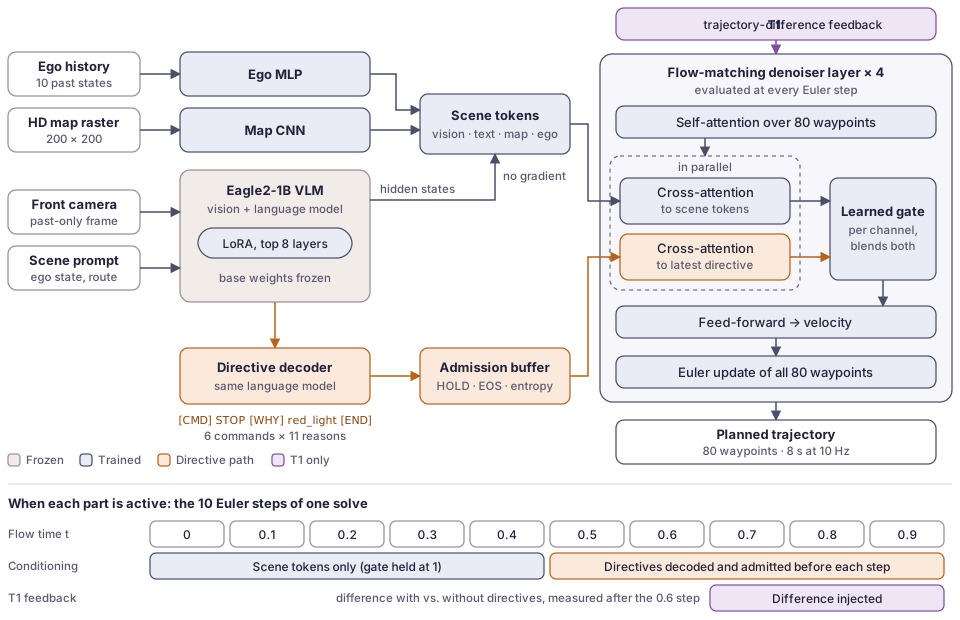
Evaluation. Four models trained for 100 epochs each on 40,000 nuPlan scenes, with a session-disjoint split (3,400 validation / 2,000 held-out test scenes), validation-only selection across 400 checkpoints, test conditions locked before test inference, and paired log-bootstrap intervals on NAVSIM PDMS.
Finding. Directives measurably change the generated trajectories but did not improve planning: the scene-only baseline scored 81.7 PDMS versus 76.1–77.0 for directive models, with losses concentrated in collision and drivable-area checks and roughly 6× inference latency. Eight-second imitation error alone did not reveal this gap.
The full thesis will be available through SJSU ScholarWorks once it is published.
Replays of plans from the thesis models on validation scenes. Pick a scene, then switch models to compare the same moment: the orange car is the model's plan, the green car is the human driver, and the right-hand panel lists the directives the model admitted.
Validation scenes from the nuPlan dataset, replayed at quarter speed. Surrounding traffic is logged and doesn't react to the model. Each clip is one saved plan from an epoch-60 checkpoint, so per-scene scores are illustrations; the thesis's held-out test results are the evidence. Camera imagery and driving logs: nuPlan (Motional).
A bidirectional LiDAR ↔ camera generative framework that imputes missing modalities under sensor dropout: a multi-layer range-image VAE, InfoNCE latent alignment over frozen Depth Anything V2 / YOLOv8 / ViT backbones, and latent diffusion for cross-modal generation. A Temporal BEV Transformer over four frames of history improved downstream BEV occupancy IoU by 15% on Argoverse 2.
A count-aware scene-token codebook, a BPE analogue for spatial layouts, that clusters multi-object descriptors into learned centroids decodable back to pixel-space boxes, with an Aligner network correcting quantization error. Validated on VQA, object localization and latent-diffusion scene reconstruction on BDD100K and KITTI.
Forecasting seismic events minutes to hours ahead from animal-behavior time-series data. 1st place, graduate division (Engineering/Science/Math), Sacramento State Research Symposium.
Unpublished manuscript on data-efficient beam alignment with CNNs, Transformers and GANs.
Contributed to research on detecting deceptive online reviews.
These papers are not published yet. Other work will be shared once approved.
College of Graduate Studies, San José State University. Nominated Feb 26, 2025.
Sacramento State, for EarthquakeNet.
Engineering/Science/Math competition, Sacramento State Research Symposium.
B.S. Computer Science, Sacramento State.
San José State University · Dec 2026
Thesis on language-guided flow-matching driving planners, defended and approved Nov 2026.
California State University, Sacramento · May 2024
GPA 3.66 · magna cum laude · Dean's Honor List
I'm open to conversations about research, AI engineering roles and collaborations.
A small live demo: the chart shows how many seconds you've spent on each section during this visit. It works best on a laptop or desktop.
Seconds spent per section this visit will appear here.
Not every visit is a person. This is my best guess at the split, made from how long each visitor stayed, how many sections they reached, what device they used and how they arrived. Read the notes underneath before trusting any of it.
Loading visitor statistics…
This site stores a random visitor ID in your browser and records your browser type, language, visit count, how you
arrived (for example ?src=linkedin) and time per section in my database, so I can see what's useful and
improve the site. To help tell people from programs it also records your screen size, time zone, whether the browser
says it is automated, whether you scrolled, clicked, tapped or typed (not what), and the order of sections you viewed.
The charts above only use coarse versions of this, never the visitor ID or the full browser string.
Separately, a third-party counter (MapMyVisitors) logs approximate location and browser
information; that data isn't stored in my database.
